Build it by voice.
Watch your AI
drive it
.
Voice Mirror is a voice-native IDE. Describe what you want, watch it render live in the App Preview, and the in-app AI sees and drives the running app — clicking, typing, and reading it to fix its own work.
unsigned alpha build — SmartScreen: “More info” → “Run anyway” · all releases
one minute — the whole loop, unmute for sound
This is Voice Mirror
A full IDE, a live App Preview, and a voice-driven AI agent — in one native Rust window.
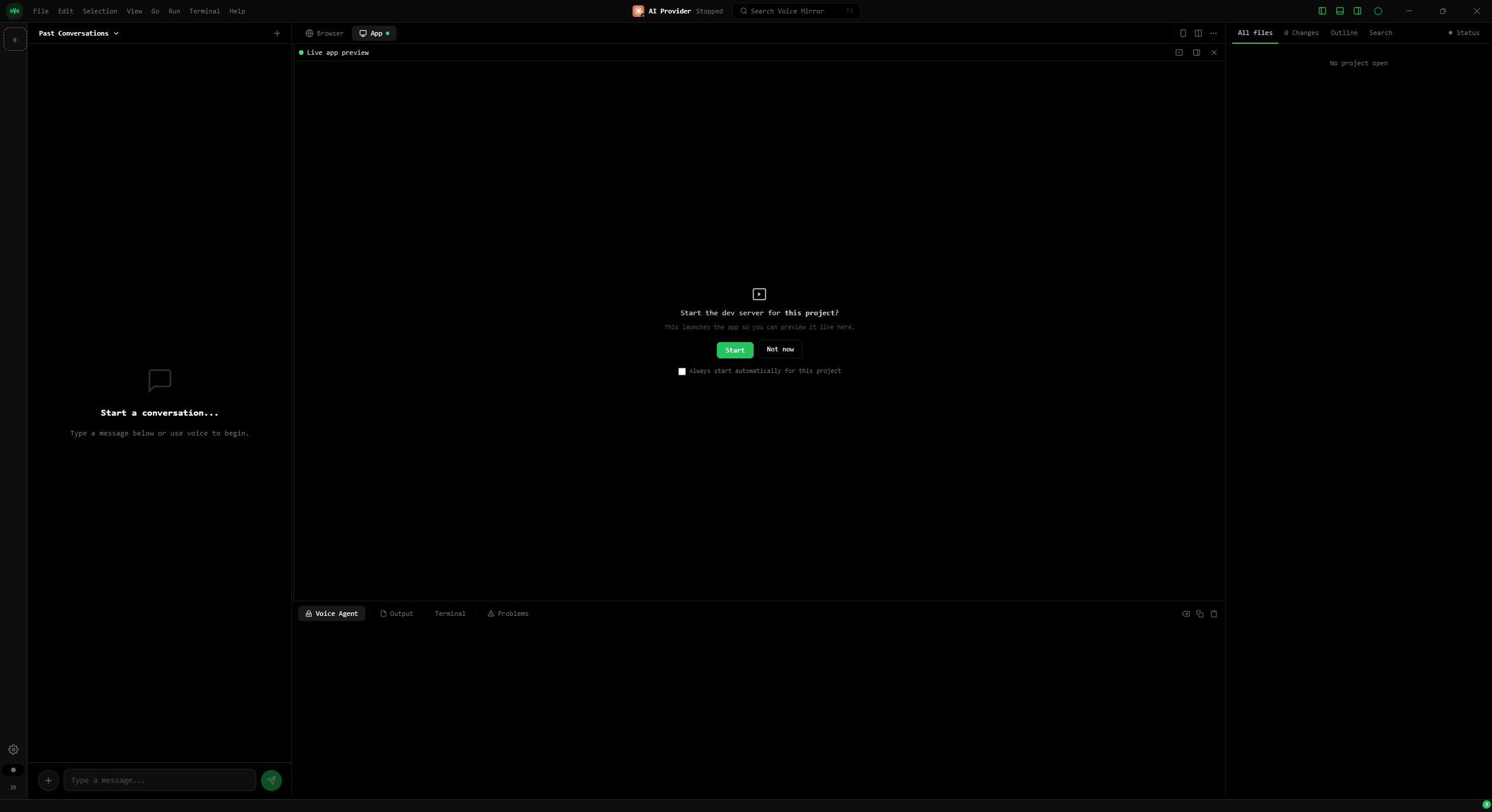
The loop
voice → build → see → fix
- 01 / voice
Say what you want
Wake word, push-to-talk, or call mode. Describe the app or the change in plain words.
- 02 / build
It writes & runs it
The AI edits the code, starts the dev server, and launches your app live in the App Preview.
- 03 / see
You both watch it run
One live surface, true to size. The AI reads the same running app you're looking at.
- 04 / fix
It drives & repairs
It clicks and types through the app, catches what's broken, and fixes the code — then speaks back.
One surface. Two engines.
Voice Mirror exposes every running app as the same accessibility tree of @ref handles. The AI clicks and types by ref — and never has to know whether it's driving a web app or a native window.
Web, Tauri & Electron
CDPStreamed live over the Chrome DevTools Protocol — the same channel that drives Voice Mirror's browser automation.
Native Windows apps
UI AutomationNotepad, Calculator, Settings, Win32/WPF/Qt — driven through UI Automation with the very same tools and refs.
$ same tools · same @refs · the AI can't tell which engine is underneath — Windows-first during alpha
A full agent, not a chat box
The see-and-drive loop rides on a complete desktop agent: it hears you, sees your screen, runs your terminal, and remembers across sessions.
Voice control
Wake word ("Hey Claude"), push-to-talk, or always-on call mode. Local Whisper in, local Kokoro out — Edge voices when you're online.
Built-in IDE
CodeMirror editor, file tree, command palette, language-server smarts, integrated terminals, and a dev-server manager.
Screen awareness
"What's this error on my screen?" — it captures your display and reasons about whatever you're looking at.
Browser automation
Real CDP control — navigate, click, fill, screenshot, read the DOM. Not "search and summarize."
Persistent memory
A three-tier memory with hybrid semantic + keyword search. Preferences and project context carry across sessions.
45 MCP tools
Five groups — core, capture, memory, browser, n8n — loaded on demand for any MCP-aware agent.
Any model. Switch without restart.
Run Claude Code for agentic coding, OpenCode to unlock 75+ models, or a local LLM for full privacy. CLI agents and cloud APIs, all behind one interface.
Rust under the hood. CPU or GPU.
The whole backend — windowing, voice pipeline, MCP server — is native Rust on Tauri 2. No Electron, no Node runtime, no Python. The voice stack runs on CPU and works fully offline — and taps your GPU when it's there to make dictation and speech instant.
Just want to talk instead of type? Meet Yap.
A tiny dictation pill for Windows: local GPU transcription on any GPU, offline AI cleanup for the "um"s and grammar, typed into whatever app you're in. Free & MIT.
Ready to build by voice?
Voice Mirror is free and open source, in active alpha on Windows. Grab the installer, or join the Discord and build along.
unsigned alpha installer — SmartScreen: “More info” → “Run anyway” · nightly channel